A coding model can explain an exception in seconds and produce a plausible patch a moment later. Yet the incident remains open. The failure has not been reproduced, a neighbouring workflow may have changed, and nobody has checked whether the repair survives the request order that caused the bug.
The latest models help most when they shorten that gap. They can trace a call across files, inspect logs, construct a competing explanation, run a test, change the implementation, and use the result to revise their next step. Debugging becomes a sequence of inexpensive experiments with a capable investigator working inside it.
The useful outcome is a verified fix: the original failure is demonstrated, the intended behaviour is restored, and the important boundaries remain intact. Faster code generation contributes to that outcome. It does not define it.
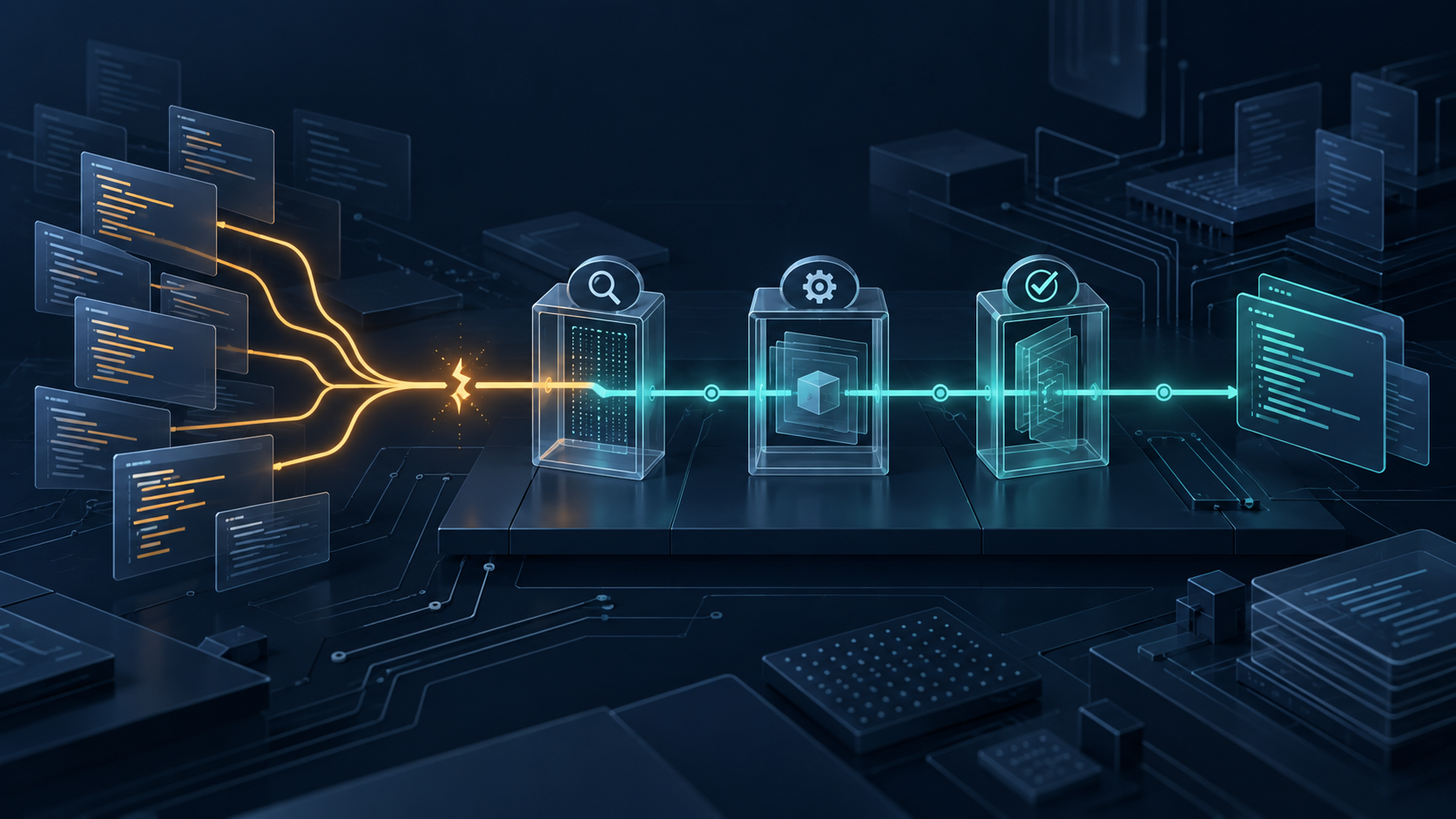
What the latest generation changes
As of 2 October 2026, the relevant development is sustained investigation and tool use across a repository. OpenAI's current model catalogue distinguishes GPT-6 Astra for demanding reasoning and coding, GPT-6.1 Sol for a balance of capability and cost, and GPT-6 Luna for focused, high-volume work. The Sol documentation explicitly recommends comparison with Astra on your own tasks. That is a better starting point than treating the flagship as the default for every search or edit.
Anthropic's September releases make a similar distinction. Claude Sonnet 5.5 is positioned for scoped work, including bug fixes; Opus 5.5 emphasises sustained judgement on more complex work. Sonnet's reported 30%+ improvement in output generation speed measures generation, not the elapsed time to a reviewed and verified repair. These are different clocks.
Google describes Gemini 3.8 Flash as improving agentic coding through additional reasoning and iterative tool calls. More reasoning can also consume more tokens. Its newly announced Gemini 4 Argon is initially restricted to trusted defenders and testers; an announcement is not general availability.
These descriptions establish capabilities and positioning, not a universal productivity ranking. In a debugging workflow, their practical value is the ability to keep a hypothesis, a repository constraint, and an observed failure connected over several steps. Screenshots can contribute visual evidence; logs and tests contribute behavioural evidence. Neither a large context window nor a polished explanation guarantees that the relevant evidence was actually examined.
Measure the clock that matters
There are at least three useful clocks: time to the first plausible explanation, time to a patch, and time to an accepted fix. Optimising the first two can worsen the third if the engineer spends the saved minutes reviewing unnecessary changes or correcting confident assumptions.
METR's early-2025 randomised study makes that distinction concrete. Sixteen experienced open-source contributors completed 246 tasks in familiar repositories. They expected AI to reduce completion time by 24% and later perceived a 20% reduction, while measured completion time increased by 19%. The following index normalises the reported percentages; it is not a new measurement.
The study is evidence about a particular population, task mix, and earlier tools. METR's February 2026 update says its newer estimates are unreliable because of selection effects and the difficulty of accounting for concurrent agent work. It does not establish a clean current speedup or slowdown. The operational lesson is to measure your own accepted outcomes rather than infer them from perceived fluency.
For a team, record wall-clock time from a ready-to-investigate defect to acceptance, active engineer time, review effort, model cost, and subsequent reopenings. Stratify by defect type and repository familiarity. Keep unresolved attempts in the denominator. A tool that rapidly solves easy failures while leaving difficult ones unfinished can otherwise look more productive than it is.
Give the model a failure contract
A useful assignment contains the observable failure, the environment, the permitted change, and the behaviour that must remain unchanged. A stack trace is an entry point. The contract tells the investigator what would count as a repair.
Consider a search interface. A user types one query, then another. The second request finishes first, but the first response eventually replaces it. The requirement is explicit: only the latest user intent may update the visible state. Clearing the query invalidates pending work. An older failure must not replace a newer success, and one search controller must not change another.
Give the agent the relevant component, its data service, the project's instructions, and a deterministic way to control response order. Ask it to trace the existing path before editing. A compact task can carry the entire verification contract:
Failure: an older search response overwrites the latest query.
Reproduce with controlled promises, not timing-based sleeps.
Trace the caller and existing cancellation/state ownership.
Show a regression that fails because of the stale result.
Preserve independent search instances and empty-query behaviour.
Fix the smallest ownership boundary; avoid unrelated edits.
Run reverse-order, clear, late-failure, and current-failure cases.
Report executed checks separately from proposed checks.
This is an editorial synthesis, not a vendor-prescribed debugging method. It gives a capable model an executable objective and enough constraints to reject attractive but incomplete repairs. Keep credentials and unnecessary customer data out of the evidence packet; sanitised fixtures should preserve the causal structure of the failure.
Turn the explanation into an executable repair
There are several credible interventions. Debouncing reduces request frequency but does not establish which response owns the screen. Cancellation saves work when supported, but completion can race with cancellation. A monotonically increasing generation gives each operation explicit ownership of the state it may replace. An established query library may already enforce that ownership; use its mechanism when available.
The following deliberately small controller isolates the rule. It does not require a browser or a network to test it. Every new intent, including clearing the query, supersedes earlier work. A current failure leaves a terminal state, so the interface can release its busy indicator.
type SearchSnapshot = Readonly<{
  query: string;
  items: readonly string[];
  status: "idle" | "loading" | "ready" | "failed";
}>;

export class SearchController {
  private generation = 0;
  state: SearchSnapshot = { query: "", items: [], status: "idle" };

  constructor(
    private readonly fetchItems: (query: string) => Promise<readonly string[]>,
  ) {}

  async search(query: string): Promise<void> {
    const run = ++this.generation;
    this.state = { query, items: [], status: query ? "loading" : "idle" };
    if (!query) return;

    try {
      const items = await this.fetchItems(query);
      if (run === this.generation) {
        this.state = { query, items, status: "ready" };
      }
    } catch {
      if (run === this.generation) {
        this.state = { query, items: [], status: "failed" };
      }
    }
  }
}
The important change is the guard around both completion paths. Protecting success while allowing an old exception to clear the current screen would leave the same ownership defect in another branch. Production integration still needs the existing UI notification mechanism, error reporting, cancellation and disposal policy; the example demonstrates one invariant rather than replacing a full search abstraction.
A deterministic regression reverses completion order. Save the controller as search.ts and the following test as search.test.ts in a TypeScript-capable test setup. The test controls the schedule directly and compares the complete visible outcome.
import assert from "node:assert/strict";
import test from "node:test";
import { SearchController } from "./search.ts";

function deferred<T>() {
  let resolve!: (value: T) => void;
  const promise = new Promise<T>((done) => { resolve = done; });
  return { promise, resolve };
}

test("the latest query owns the visible result", async () => {
  const older = deferred<readonly string[]>();
  const newer = deferred<readonly string[]>();
  const search = new SearchController(
    (query) => query === "old" ? older.promise : newer.promise,
  );

  const first = search.search("old");
  const second = search.search("new");
  newer.resolve(["new result"]);
  await second;
  older.resolve(["old result"]);
  await first;

  assert.deepEqual(search.state, {
    query: "new", items: ["new result"], status: "ready",
  });
});
Remove the generation checks and this assertion fails on the stale response. That sensitivity matters: a green test that merely checks whether a request returned cannot distinguish the repair from the original defect. Extend the same controlled schedule to clearing, an older rejection, a current rejection, and two independent controllers. Expected states should come from the requirement, not from reproducing the implementation's guard in the test.
Make the environment part of the investigation
Better reasoning cannot compensate for a test that silently never runs or a database substitute with different transaction semantics. A missing dependency, an occupied port, and a reproduced business failure are three different results. The agent should identify which one it observed before treating an experiment as evidence.
Anthropic's infrastructure-noise experiment held the model, harness and Terminal-Bench 2.0 tasks fixed while varying resource headroom. Infrastructure error rates changed materially:
This is not a recommendation to remove resource limits. It shows why evaluation includes the environment. A capable agent repeatedly failing to start the application has not tested the repair. Capture the source revision, runtime, configuration, fixtures and exact checks so another engineer can reproduce the result.
Match verification to the defect. A pure state controller permits deterministic local tests. A persistence bug needs an independent read after the operation, ideally through a new context. An authorisation bug needs a denied call and proof of no side effect. A browser bug needs the actual interaction and visible result. Keep neighbouring entities in the fixture whenever an incorrect selection could affect them.
Parallelise uncertainty, then reconcile the evidence
Additional agents are useful when their questions are independent. One can trace the production call chain while another designs a reproduction; a third can review the eventual diff for omitted boundaries. A stronger reasoning model can challenge a difficult causal explanation while a lighter model performs a bounded search. Shared editing and competing implementations require coordination, otherwise the team buys merge work instead of investigation speed.
Anthropic's long-running-agent harness report describes incremental work, durable progress artefacts and direct verification as mechanisms for avoiding premature completion. Its agent-evaluation guidance also distinguishes an agent's transcript from the actual resulting environment. An independent reviewer should therefore inspect the diff and reproduce key evidence, not simply endorse the first agent's explanation.
The handoff needs only a few durable facts: the reproduced condition, the cause, the ownership boundary changed, the checks actually run, and the remaining uncertainty. Carry those facts across long sessions. Repeatedly rediscovering the same contract wastes both human attention and model compute.
Build a shorter evidence loop
The operating sequence is straightforward, but its order matters. A patch should follow a discriminating experiment, and acceptance should follow verification of the final revision.
- FrameRecord the failure, environment, permitted effect and important unchanged boundaries.
- ReproduceCreate a deterministic failing scenario and distinguish the defect from environment errors.
- RepairChange the established ownership or domain boundary and retain a focused regression.
- ChallengeExercise failure paths, neighbouring entities and a controlled return of the defective condition.
- AcceptVerify the final revision, inspect the diff, review remaining uncertainty and measure total effort.
Start with a small cohort of real defects. Keep the existing acceptance standard, record the model and tooling, and compare similar tasks over time. Spend stronger reasoning where uncertainty is costly; use faster execution where the task is already bounded. Retain the regression even when the model that produced it has been replaced.
The latest models can make debugging faster because they make investigation and iteration cheaper. A team captures that advantage when it converts each explanation into a testable claim and each patch into evidence that survives review. The enduring asset is the verified behaviour and its regression protection; the model is the increasingly capable collaborator that helps produce them.